
Fred Hampton & The Rainbow Coalition of
Revolutionary Solidarity, 1969
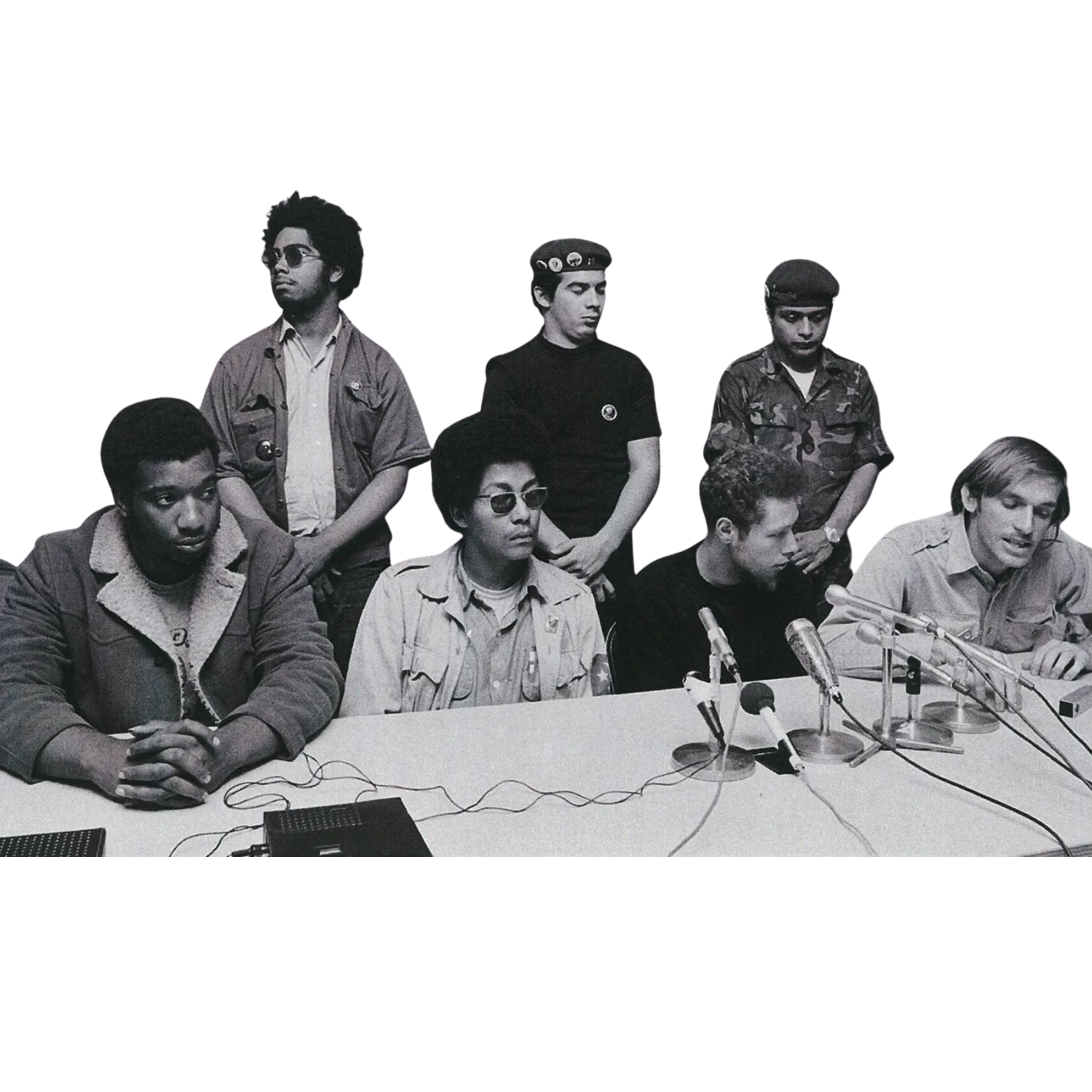
“We’re gonna fight racism not with racism, but we’re gonna fight with solidarity. We say we’re not gonna fight capitalism with black capitalism, but we’re gonna fight it with socialism”
Who He Was
Fredrick Allen Hampton was born on Chicago's South Side to Francis and Iberia Hampton, a family that had migrated from Louisiana. He grew up in Maywood, Illinois, where, as a teenager, he organized a 500-member youth council for the NAACP's West Suburban Branch and served on his high school's Interracial Cross Section Committee, early proof of both his talent for institution-building and his instinct for coalition work across racial lines.¹ By the time he enrolled at Triton Junior College to study pre-law, he was already reading police violence as a systemic problem, not a series of isolated incidents. By 1968, he had concluded the NAACP's procedural approach was too constrained for what the moment demanded and joined the Black Panther Party as one of the Illinois chapter's founding members.²
Hampton rose through the BPP with uncommon speed. At 20, he was running five breakfast programs across Chicago's West Side, operating a free medical clinic, conducting political education classes, and brokering a peace agreement among the city's most powerful street gangs, arguing that racial and ethnic conflict only kept working people entrenched in poverty and served the interests of those who oppressed them all.³ By late 1969, he had been appointed to the Party's national Central Committee and was being groomed for the position of Chief of Staff, the highest operational rank in the organization.⁴ He was 21 years old.
What set Hampton apart was not simply his oratory, though by all accounts it was extraordinary, but his theoretical clarity. He understood class as the structural substrate beneath racial oppression. He did not ask groups to set aside their specific identities. He asked them to see what those identities shared: exploitation, dispossession, police violence, inadequate housing, exclusion from health care. He called this framework "internationalism", fighting racism not with racial nationalism but with solidarity. It was this framework that produced the Rainbow Coalition.
What He Built and Fought For
The Rainbow Coalition of Revolutionary Solidarity was formally announced in May 1969, though it had been taking shape through a series of relationships Hampton and Illinois BPP Field Secretary Bob Lee had been cultivating since late 1968.⁵ The coalition's three founding pillars were: the Illinois Chapter of the Black Panther Party, which organized Chicago's African American community on the West Side; the Young Lords Organization, a Puerto Rican civil rights group led by José "Cha Cha" Jiménez that had just transformed itself from a street gang into a political organization fighting displacement and police brutality in Lincoln Park; and the Young Patriots Organization, a leftist group of Appalachian white migrants, people who had left Kentucky, West Virginia, and Tennessee for Chicago and found themselves living in slum conditions in Uptown, targets of class contempt from the same city structures that suppressed Black and Latino neighborhoods.⁶
The sheer fact of this alliance was itself a political act. Chicago was, and remains, one of the most racially segregated cities in the United States. Hampton was asking poor Black people, poor Puerto Rican people, and poor white Southern migrants, groups who historically competed against and frequently clashed with each other, to look past the racial arrangements that kept them divided and recognize their shared class position. The Young Patriots, who still flew a Confederate flag when the coalition first formed, eventually removed it. This wasn't Hampton performing moral instruction at people. He was organizing them on material terrain.⁷
The coalition later expanded to include Students for a Democratic Society, the Brown Berets, the American Indian Movement, Rising Up Angry (a white working-class youth group formed explicitly to support the coalition), and the Red Guard Party, among others.⁸
Concrete programs the coalition operated included:
Community survival programs were central to the coalition's work, run not as charity but as models of what governance prioritizing people over profit could look like. These included the Young Patriots Free Health Clinic, which provided medical care to low-income white residents excluded from mainstream healthcare; free breakfast programs and food pantries combating food insecurity across multiple neighborhoods; legal services for community members; and joint marches against police brutality.⁹
Hampton personally led five separate breakfast programs on Chicago's West Side, feeding more than 400 children every morning before school. The success of the Illinois program directly pressured the city of Chicago to use federal funds to provide hot breakfasts to poor children across the city, a measurable, government-scale consequence of community organizing.¹⁰ A 1969 U.S. Senate hearing would produce testimony from the national School Lunch Program administrator acknowledging that the Black Panthers were feeding more poor school children than the state of California.¹¹
Hampton also negotiated a formal nonaggression pact among Chicago's most powerful street gangs, a feat that had eluded city government and law enforcement entirely. He accomplished this through the same logic he applied to the coalition: gangs killing each other over territory was a trap set by poverty and divided by race; the real enemy was the system that had arranged those conditions.¹²
Beyond direct service, the coalition operated as a mutual solidarity network. When the Young Lords held a rally for Manuel Ramos, a member killed by an off-duty police officer in May 1969, Illinois Black Panthers and Young Patriots showed up without being asked. When any coalition group had a protest, demonstration, or confrontation with authorities, the others came. Coalition members also cross-organized: Hampton replaced the word "white man" with "capitalist" in the third point of the BPP's Illinois Ten-Point Program, a small but deliberate ideological move signaling that the coalition's enemy was a class relation, not a racial category.¹³
By the time Hampton was killed, he was on track to become the most powerful operational leader in the national Black Panther Party. The FBI understood exactly what that meant for the coalition's reach.
Who Came for Him, and How
The apparatus deployed against Hampton was not improvised. It was a structured, federally coordinated program of sabotage, infiltration, provocation, and ultimately assassination, documented in declassified materials, confirmed by the U.S. Senate Church Committee, and cemented in federal court findings.
The FBI opened a file on Hampton in 1967, when he was 18 years old. By February 1968, they were wiretapping his mother's phone. By May 1968, they had placed him on the bureau's "Agitator Index" as a "key militant leader."¹⁴
The Infiltration: In late 1968, the FBI's Racial Matters Squad at the Chicago field office recruited William O'Neal, who had recently been arrested twice, for interstate car theft and for impersonating a federal officer. In exchange for having his felony charges dropped and receiving a monthly stipend, O'Neal agreed to infiltrate the BPP as a counterintelligence operative. He joined the party and rose to become Director of Chapter Security and Hampton's personal bodyguard. O'Neal had keys to multiple Panther headquarters and safe houses. He had total physical access.¹⁵
Disinformation Campaigns: The FBI circulated racist cartoons under the BPP's name, specifically designed to alienate white activists and undermine the Rainbow Coalition. It launched targeted disinformation operations to sow distrust between the Panthers and the Blackstone Rangers street gang, at FBI instruction. O'Neal instigated an armed clash between them on April 2, 1969. The FBI ran a parallel campaign to create rifts between the Panthers and Students for a Democratic Society. In repeated internal directives, J. Edgar Hoover personally demanded that COINTELPRO personnel "destroy what the [BPP] stands for" and "eradicate its 'serve the people' programs."¹⁶ This is documented in the FBI's own files.
The Assassination: On the evening of December 3, 1969, Hampton taught a political education class at a local church. Afterward, he and several Panthers returned to his apartment, where O'Neal had prepared dinner. O'Neal slipped secobarbital, a fast-acting barbiturate, into Hampton's drink. Hampton fell asleep mid-sentence while on the phone with his mother. He never woke up.¹⁷
Before the raid, O'Neal had provided FBI control agent Roy Martin Mitchell with a detailed floor plan of Hampton's apartment at 2337 West Monroe Street, including the specific location of the bed where Hampton slept. Mitchell passed the floor plan to Cook County State's Attorney Edward Hanrahan's office, which coordinated the raid.¹⁸
At 4:45 a.m. on December 4, 1969, a 14-man armed Chicago Police unit stormed the apartment. They first shot and killed Mark Clark, the BPP's Peoria chapter leader, who was sitting in the front room on security duty. Moving to the back bedroom, officers found Hampton unconscious, drugged, beside his pregnant fiancée, Deborah Johnson (Akua Njeri), who was eight and a half months pregnant. Officers shot Hampton multiple times. According to Njeri's testimony, after he was initially wounded but not yet dead, an officer approached his body and fired two bullets into his head. She heard another officer say, "He's good and dead now."¹⁹
In total, police fired between 90 and 99 shots into the apartment. The Panthers fired one, from Mark Clark, who had been shot while still in the front room.²⁰
State's Attorney Hanrahan held a press conference that morning, calling it a "gun battle" instigated by the Panthers. The seven surviving occupants were arrested and charged with attempted murder. Investigators who entered the apartment in the hours after the raid found bullet holes concentrated overwhelmingly from the outside in, around Hampton's bedroom. The physical evidence demolished Hanrahan's account before the day was out. Charges against all seven were eventually dropped.²¹
The Cover-Up: The FBI's central role was concealed for years. The first crack came in March 1971, when a group of antiwar activists broke into an FBI field office in Media, Pennsylvania, and extracted over 1,000 documents, which, when distributed to journalists and lawyers, revealed the existence of COINTELPRO. In 1973, U.S. Attorney James Thompson revealed that O'Neal had been an FBI informant. Civil rights attorneys from the People's Law Office, who had filed suit on behalf of Hampton and Clark's families in June 1970, subpoenaed the Chicago FBI's BPP files and discovered the floor plan memo, which specifically marked Hampton's bed.²²
In 1975, Church Committee investigators informed the People's Law Office attorneys of Chicago of documents establishing a direct link between the FBI and the raid. A document dated December 3, 1969, one day before the raid, explicitly claimed the planned operation as a COINTELPRO project. Among the documents eventually produced was a memo approving a $300 bonus payment to O'Neal for his floor plan, with the FBI noting his information was of "tremendous value" and had made the raid a "success."²³
In January 2021, a FOIA request by historian Aaron Leonard produced additional FBI documents, including a letter dated six days after Hampton's murder, from J. Edgar Hoover's own desk, thanking Chicago FBI agent Roy Martin Mitchell for his "exemplary efforts" and approving an incentive award for his "outstanding services in a matter of considerable interest to the FBI in the racial field."²⁴ Documents from that same FOIA release, 51 years after the raid, still contained redactions.
The Legal Outcome: In 1979, the U.S. Court of Appeals for the Seventh Circuit found there was substantial evidence of a conspiracy between the FBI, Hanrahan's office, and the Chicago Police Department to murder Hampton and destroy the Black Panther Party, and that the FBI had obstructed justice by suppressing 200 volumes of documents during litigation.²⁵ In 1982, after 13 years of litigation in what became the longest civil rights trial in federal court history, the city of Chicago, Cook County, and the federal government agreed to a $1.85 million settlement, at the time the largest in a civil rights case. The government admitted no wrongdoing. Not a single officer, agent, or official was ever criminally convicted.²⁶
What He Left Behind
The Rainbow Coalition didn't simply inspire later movements. It seeded them directly.
The most visible downstream consequence is electoral. Harold Washington, who in 1983 became the first Black mayor of Chicago, explicitly built his multiracial coalition campaign on the infrastructure and voter registration work the Rainbow Coalition had produced. The thousands of Puerto Rican Chicagoans the Young Lords had organized through the late 1960s and into the 1970s were a core constituency in Washington's coalition. Washington created a "Rainbow Cabinet" in office that was directly modeled on Hampton's framework and tasked with addressing cross-racial, class-based inequality.²⁷
Jesse Jackson appropriated the name for his own use, first for the nonprofit he founded in 1971, and then nationally when he ran for the Democratic presidential nomination in 1984 and 1988. Framing his campaign as a "Rainbow Coalition," Jackson won 11 primaries and caucuses in 1988, secured more than seven million votes, and finished second in the Democratic delegate count, registering millions of new voters and pressing the Democratic Party platform toward more progressive positions on healthcare, voting rights, and apartheid in South Africa.²⁸ The lineage from Hampton's Chicago coalition to Jackson's national campaign to the multiracial electorate that is now taken as a baseline political fact is not metaphorical. It is structural.
David Axelrod, the political consultant who had worked on Harold Washington's campaign, later brought those coalition strategies to Barack Obama's 2008 presidential run. Obama himself cited Washington's tenure as a direct inspiration.²⁹
The BPP's Free Breakfast Program, which Hampton ran at scale in Chicago, is the direct antecedent of the federally funded National School Breakfast Program. In 1969, a U.S. Senate hearing produced testimony acknowledging that the Panthers were feeding more poor children than the state of California. The program proved a publicly funded version was both necessary and politically achievable. This is not a coincidence. It is cause and effect.³⁰
Fred Hampton Jr., born weeks after his father's assassination, has continued organizing for decades, advocating for political prisoners including Mumia Abu-Jamal and Assata Shakur, and continuing the work of the Prisoners of Conscience Committee.³¹
The 2021 film Judas and the Black Messiah, directed by Shaka King, brought Hampton's story to a wide audience and reignited public attention to COINTELPRO's role in his assassination, coinciding with the FOIA release of new documents confirming Hoover's personal involvement.
Why It Still Matters
Fred Hampton was killed because his model worked. A 21-year-old man in one of the most segregated cities in the country had convinced Black West Siders, Puerto Rican North Siders, and white Appalachian migrants to walk into rooms together, identify their shared enemy, and build material institutions, breakfast programs, health clinics, and legal aid that the state had refused to provide. He was doing this while also organizing street gang truces and being groomed for the national leadership of the most feared radical organization in the United States.
J. Edgar Hoover's FBI was not afraid of the Panthers' guns. They were afraid of Fred Hampton's grammar. The word "capitalist" replaces "white man" in the Ten-Point Program. The phrase "fight racism with solidarity." These were tools that could collapse the racial fault lines American power had always depended on to prevent a working-class coalition. The government did not infiltrate and assassinate Hampton because he was violent. It did so because he was effective, and because his model, scaled, would have been genuinely threatening to the structures that distributed power and resources in this country.
The questions Hampton's coalition raised have not been answered. Black and Latino poverty in Chicago remains geographically concentrated in ways that trace directly to the urban renewal displacement campaigns the Young Lords were fighting in 1969. Police violence against Black and Brown communities has produced a half-century of consent decrees, settlements, and reforms that have not solved the underlying dynamic. The school breakfast program Hampton's organizing helped force into existence remains underfunded and under attack. The surveillance and infiltration tactics of COINTELPRO, still without redactions on some documents, have been adapted and updated, documented in federal investigations of "Black Identity Extremism" designations as recently as 2017.
What Hampton demonstrated is that multiracial, class-conscious organizing, not as a theory but as a lived, structured practice, is among the most threatening things a person can do inside the United States. The state's response to it is the most honest measure of how seriously that threat is taken.
Key Quotes
"We're gonna fight racism not with racism, but we're gonna fight with solidarity. We say we're not gonna fight capitalism with black capitalism, but we're gonna fight it with socialism."³²
"You can jail a revolutionary, but you can't jail the revolution. You can kill a revolutionary, but you can't kill the revolution."³³
"I am a revolutionary. You're going to have to keep on saying that."³⁴
"Power anywhere where there's people."³⁵
Sources & Citations
Britannica. "Fred Hampton." Encyclopædia Britannica. https://www.britannica.com/biography/fred-hampton
xxxxxx.
Wikipedia. "Fred Hampton." Wikipedia. https://en.wikipedia.org/wiki/Fred_Hampton
xxxxxx.
Wikipedia. "Rainbow Coalition (Fred Hampton)." Wikipedia. https://en.wikipedia.org/wiki/Rainbow_Coalition_(Fred_Hampton)
WTTW Chicago. "The First Rainbow Coalition." Chicago Stories. https://www.wttw.com/chicago-stories/young-lords-of-lincoln-park/the-first-rainbow-coalition
Ibid.
Wikipedia. "Rainbow Coalition (Fred Hampton)." Wikipedia. https://en.wikipedia.org/wiki/Rainbow_Coalition_(Fred_Hampton)
xxxxxx.
Wikipedia. "Free Breakfast for Children." Wikipedia. https://en.wikipedia.org/wiki/Free_Breakfast_for_Children
DIG Podcast. "The Black Panther Party and the Free Breakfast Program." digpodcast.org. https://digpodcast.org/2020/07/19/black-panther-party/
Wikipedia. "Fred Hampton." Wikipedia. https://en.wikipedia.org/wiki/Fred_Hampton
Wikipedia. "Rainbow Coalition (Fred Hampton)." Wikipedia. https://en.wikipedia.org/wiki/Rainbow_Coalition_(Fred_Hampton)
Wikipedia. "Fred Hampton." Wikipedia. https://en.wikipedia.org/wiki/Fred_Hampton
Wikipedia. "William O'Neal (informant)." Wikipedia. https://en.wikipedia.org/wiki/William_O%27Neal_(informant)
Wikipedia. "COINTELPRO." Wikipedia. https://en.wikipedia.org/wiki/COINTELPRO
Wikipedia. "William O'Neal (informant)." Wikipedia. https://en.wikipedia.org/wiki/William_O%27Neal_(informant)
Taylor, Flint. "The FBI COINTELPRO Program and the Fred Hampton Assassination." HuffPost Chicago. December 3, 2013. https://www.huffpost.com/entry/the-fbi-cointelpro-progra_b_4375527
Britannica. "Fred Hampton." Encyclopædia Britannica. https://www.britannica.com/biography/fred-hampton
Gale Blog. "Fred Hampton's Murder, the Black Panthers, and Primary Sources." blog.gale.com. December 2019. https://blog.gale.com/fred-hamptons-murder-the-black-panthers-and-primary-sources/
History.com. "The 1969 Raid That Killed Black Panther Leader Fred Hampton." May 28, 2025. https://www.history.com/articles/black-panther-fred-hampton-killing
Taylor, Flint. "The FBI COINTELPRO Program and the Fred Hampton Assassination." HuffPost Chicago. December 3, 2013. https://www.huffpost.com/entry/the-fbi-cointelpro-progra_b_4375527
xxxxxx.
Taylor, Flint, and Jeff Haas. "New Documents Suggest J. Edgar Hoover Was Involved in Fred Hampton's Murder." Truthout. January 20, 2021. https://truthout.org/articles/new-documents-suggest-j-edgar-hoover-was-involved-in-fred-hamptons-murder/
People's Law Office. "The Fred Hampton Appeal." peopleslawoffice.com. https://peopleslawoffice.com/about-civil-rights-lawyers/history/the-fred-hampton-appeal/
Wikipedia. "Fred Hampton." Wikipedia. https://en.wikipedia.org/wiki/Fred_Hampton; History.com (see citation 21).
NPR Code Switch. "The Story Behind the Original Rainbow Coalition." npr.org. January 25, 2023. https://www.npr.org/transcripts/1150867899
Harper, Constance. "Jesse Jackson and the Political Imagination We Inherit." Word in Black. March 2, 2026. https://wordinblack.com/2026/03/jesse-jackson-legacy-economic-justice/
Wikipedia. "Rainbow Coalition (Fred Hampton)." Wikipedia. https://en.wikipedia.org/wiki/Rainbow_Coalition_(Fred_Hampton)
Averill, Elizabeth. "The Black Panther Party and the Free Breakfast Program." DIG Podcast. July 19, 2020. https://digpodcast.org/2020/07/19/black-panther-party/
Dhillon, Sunny. "The Greatest Threat to the Internal Security of the USA." Medium. March 2021. https://dsdhillon.medium.com/the-greatest-threat-to-the-internal-security-of-the-usa-the-black-panther-free-breakfast-for-e797636c5f94
Hampton, Fred. Speech, 1969. Quoted in Journal of African American Studies. Springer. November 2019. https://link.springer.com/article/10.1007/s12111-019-09454-6
Quoted widely. Original attribution: Fred Hampton, Illinois BPP organizational meetings, 1969. QuotePoem compendium: https://quotepoem.com/rule/fred-hampton-quotes/
Judas and the Black Messiah (2021), dir. Shaka King — sourcing original audio from BPP organizing meetings, 1969.
Hampton, Fred. Quoted in: South Side Weekly. "Fifty Years of Fred Hampton's Rainbow Coalition." February 14, 2021. https://southsideweekly.com/fifty-years-fred-hampton-rainbow-coalition-young-lords-black-panthers/