
Queen Lili'uokalani
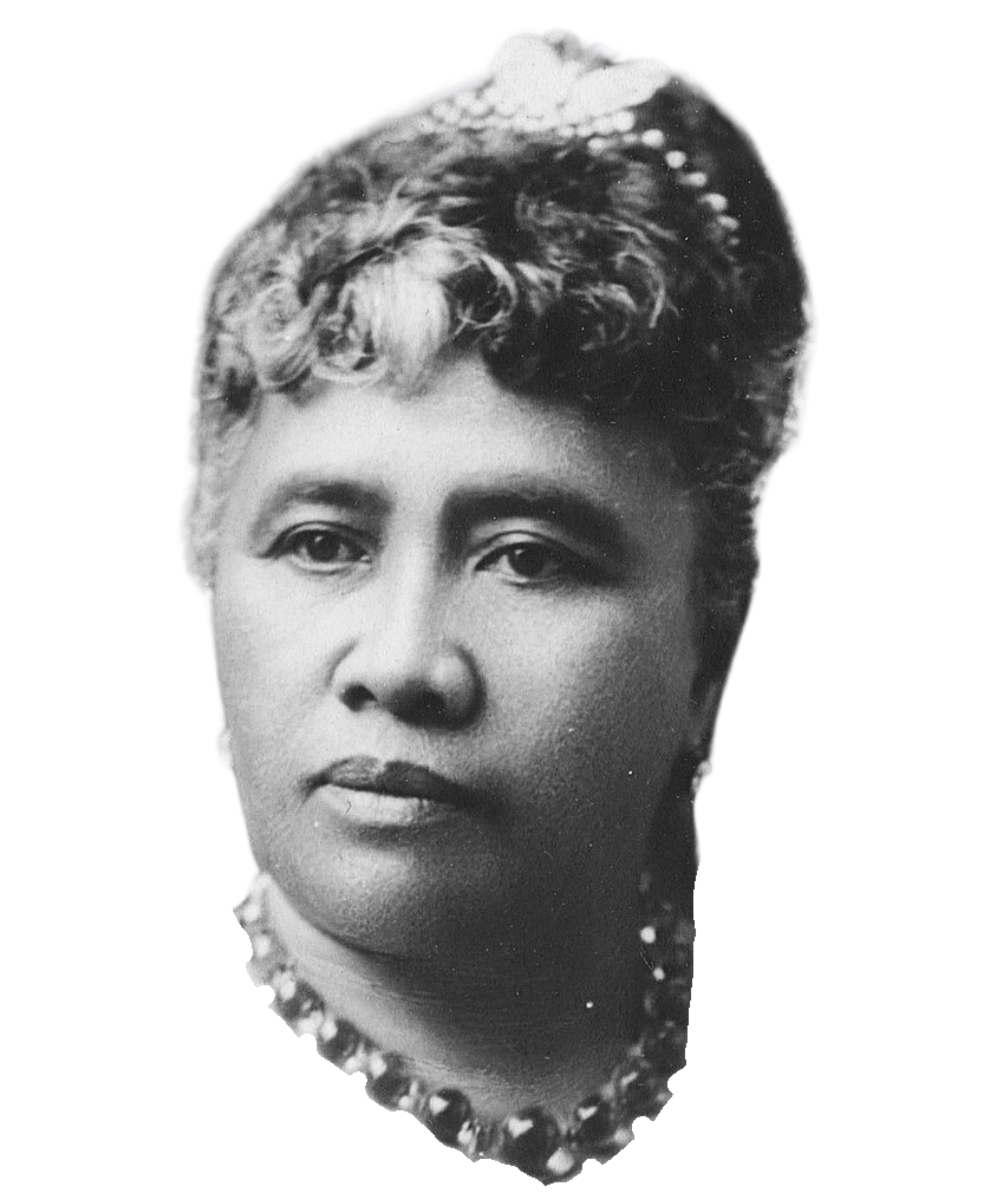
““I would undertake anything for the benefit of my people. It is for them that I would give my last drop of blood.””
Born: September 2, 1838, Honolulu, Hawaiʻi | Died: November 11, 1917, Honolulu, Hawaiʻi (stroke, age 79) Role/Title: Queen Regnant – Last Sovereign Monarch of the Hawaiian Kingdom Country/Region: Kingdom of Hawaiʻi
Who She Was
Lydia Liliʻu Loloku Walania Kamakaʻeha was born on September 2, 1838, and would become the only queen regnant and last sovereign monarch of the Hawaiian Kingdom. From the beginning, her life was shaped by two worlds in tension: the deeply rooted traditions of Native Hawaiian nobility and the missionary-influenced Western education being imposed on the islands. Her mother was an advisor to Kamehameha III, the king who promulgated the first written constitution to the Hawaiian people in 1840. Following the Hawaiian tradition of hānai, a practice of adoption that strengthened alliances among chiefs… she was raised by High Chief and Chiefess Pāki and Konia, and her claim to the throne was established through this lineage.¹
She was a talented haku mele, or music composer, saying "to compose was as natural to me as to breathe." In 1866, at the behest of Kamehameha V, she composed a national anthem for Hawaiʻi, "He Mele Lāhui Hawaiʻi," that was used for the next twenty years.
When King Kalākaua died in January 1891, Liliʻuokalani ascended the throne, becoming the first woman ever to occupy it. She inherited a kingdom already under siege, economically, politically, and constitutionally. What she then chose to do with power demonstrated exactly why the forces aligned against her feared her: she governed not in the interest of foreign capital, but in the interest of her people.³
What She Built and Fought For
The central mission of Liliʻuokalani's reign was the restoration of Hawaiian sovereignty, specifically, the reversal of the political dispossession engineered by white American and European planters against her brother's reign.
In 1887, a group of influential white sugar planters led by attorneys Lorrin Thurston and Sanford B. Dole had taken advantage of a spending scandal involving Kalākaua to demand, at gunpoint, that he sign a new constitution stripping the Hawaiian monarchy of most of its power. Known as the Bayonet Constitution, the document allowed foreign residents to vote and restricted the suffrage rights of Asian workers and those who had low incomes or did not own property. Suddenly, three out of four Native Hawaiians could no longer vote.⁴
Liliʻuokalani had watched this happen and had no intention of allowing it to stand. Petitions for a new constitution poured in from every part of the islands. It was estimated that out of a possible 9,500 registered voters, 6,500, two-thirds, had signed these petitions.⁵ She was not acting in defiance of the people. She was acting on their explicit mandate.
The 1893 constitution she was attempting to promulgate would have increased suffrage by reducing some property requirements, and eliminated the voting privileges extended to European and American residents who were not citizens of Hawaiʻi. It would have returned political power to Native Hawaiians, the very thing the sugar economy depended on preventing.⁴
Beyond the constitutional battle, the 1892 Highways Act was one example of her diligent labor as queen for the welfare of her people. It defined and protected Hawaiian trails and endures as a tool that the state of Hawaiʻi uses to claim public trails and maintain rights of access despite private land ownership, including much of the Ala Kahakai National Historic Trail.¹
She also made her opposition to U.S. commercial exploitation structurally clear. She had earlier opposed the renewed Reciprocity Treaty of 1887, signed by Kalākaua, which granted privileged commercial concessions to the United States and ceded to them the port of Pearl Harbor.¹ This was not sentiment. This was sovereign governance, the understanding that territorial concessions to foreign powers were the opening moves of colonial absorption. She read it correctly.
Who Came for Her, and How
The forces arrayed against Liliʻuokalani were not a spontaneous uprising. They were a premeditated network of American business interests, foreign residents, and a U.S. diplomatic official who had already decided what they wanted: annexation. The queen's attempt to restore Hawaiian constitutional power was simply the pretext they needed.
The Committee of Safety was composed of seven foreign-born permanent residents and six Hawaiian-born people of American descent. Threatened by her attempts to abrogate the Bayonet Constitution, pro-American elements in Hawaiʻi overthrew the monarchy on January 17, 1893. The overthrow was bolstered by the landing of U.S. Marines under John L. Stevens to protect American interests, which rendered the monarchy unable to protect itself.⁶
The local sugar planters and businessmen instigated an overthrow, fearing a loss of revenue and the influence of the Queen. With the help of U.S. Marines, they forced Queen Liliʻuokalani to surrender the Hawaiian Kingdom to the United States in 1893.³
The queen understood precisely what she was up against. When she yielded, she did not surrender to the provisional government; she surrendered to the United States government, explicitly, under protest. Her formal statement read:
*"I, Liliʻuokalani, by the Grace of God and under the Constitution of the Hawaiian Kingdom, Queen, do hereby solemnly protest against any and all acts done against myself and the Constitutional Government of the Hawaiian Kingdom… I yield to the superior force of the United States of America, whose Minister Plenipotentiary has caused United States troops to be landed at Honolulu… Now to avoid any collision of armed forces, and perhaps the loss of life, I do this under protest and impelled by said force yield my authority until such time as the Government of the United States shall, upon facts being presented to it, undo the action of its representatives."*⁷
The Blount Report, delivered to President Cleveland on July 17, 1893, concluded that "United States diplomatic and military representatives had abused their authority and were responsible for the change in government." Minister Stevens was recalled, and the military commander of forces in Hawaiʻi was forced to resign his commission.⁸
President Cleveland described the coup as "an act of war, committed with the participation of a diplomatic representative of the United States and without authority of Congress."⁹ He called for her reinstatement. But Sanford Dole defied the order, claiming that Cleveland did not have the authority to interfere.¹ The coup held.
Queen Liliʻuokalani became the target of what can only be described as a vicious smear campaign in the U.S. press. The San Francisco Examiner described her as a "black pagan queen who wanted nothing short of absolute monarchy."² The propaganda was deliberate. Dehumanization has always been the colonial tool that makes theft legible to the public.
In 1895, Liliʻuokalani was imprisoned for eight months at ʻIolani Palace for her alleged knowledge of a counterrevolutionary attempt by her supporters, although it was never proven. Fearing she would never leave the palace alive, she translated Kalākaua's text of the cosmogenic Hawaiian creation chant "Kumulipo" into English, with the hope that the rest of the world would know Hawaiian heritage.³
On January 24, 1895, under threat of execution of her imprisoned supporters, Liliʻuokalani was forced to abdicate the Hawaiian throne.⁶ The abdication was not voluntary. It was extracted by the threat of watching others die.
Queen Liliʻuokalani and her fellow citizens successfully protested the annexation by petitioning Congress. The petition gathered over 37,000 signatures, a remarkable act of organized resistance. It was ignored. His successor, William McKinley, was not sympathetic, and his government, seeing the need for a military foothold in the Pacific region during the Spanish-American War, annexed Hawaiʻi in July 1898.²
What She Left Behind
Liliʻuokalani never stopped fighting. After her overthrow, she traveled to Washington and continued to press her case through every legal and political channel available to her. She wrote her autobiography, Hawaiʻi's Story by Hawaiʻi's Queen (1898), not as a memoir, but as testimony. It was a deliberate, first-person historical record designed to ensure the world could not claim ignorance of what had been done.
As head of the ʻOnipa'a movement, whose name means "immovable," "steadfast," "firm," "resolute," and whose motto was "Hawaiʻi for the Hawaiians", Liliʻuokalani fought bitterly against annexation of the islands by the United States.¹
When Hawaiʻi was annexed by the United States in 1898, Liliʻuokalani declined the offer to watch the annexation ceremonies, as she could not bear to see the Hawaiian flag lowered and the Stars and Stripes put in its place. For the rest of her life, she fought to preserve native Hawaiian rights and traditions.²
She also left behind the Liliʻuokalani Trust, a charitable organization she founded in 1909 to provide for orphaned and destitute children of Hawaiʻi, with preference given to Native Hawaiian children. That institution still operates today. Her care for her people was institutional, not symbolic.
In 1993, on the 100th anniversary of the overthrow, Congress passed the Apology Resolution, Public Law 103-150, signed by President Bill Clinton, which acknowledged that "the overthrow of the Kingdom of Hawaiʻi occurred with the active participation of agents and citizens of the United States," and further acknowledged that "the Native Hawaiian people never directly relinquished to the United States their claims to their inherent sovereignty as a people over their national lands, either through the Kingdom of Hawaii or through a plebiscite or referendum."¹⁰ The apology came without reparations, without land restoration, and without a legal pathway to sovereignty. It was acknowledgment without redress.
Why It Still Matters
The present-day consequences of the 1893 overthrow are not historical abstractions. They are measurable, documented, and ongoing.
Native Hawaiian and Pacific Islanders account for only 10% of the state's overall population, but make up 35% of the state's houseless population.¹¹ Native Hawaiians have the shortest life expectancy in Hawaiʻi and exhibit higher mortality rates than the total population due to heart disease, cancer, stroke, and diabetes. They are more likely to live below the poverty level, experience higher rates of unemployment, live in crowded and impoverished conditions, and experience imprisonment.¹² These are the compounded outcomes of land dispossession, political marginalization, and the systematic dismantling of a self-sufficient Indigenous society.
NHs have described a collective feeling of kaumaha, a heavy, oppressive sadness, resulting from mass land dispossession, overthrow of the Hawaiian Kingdom, cultural loss, and early loss of loved ones.¹³ Historical trauma is not a metaphor. It is transmitted, measurable, and documented in health outcomes across generations.
The Hawaiian sovereignty movement today is a grassroots political and cultural campaign to reestablish an autonomous or independent nation, with some groups advocating redress from the United States for what is described as a prolonged military occupation beginning with the 1898 annexation. The movement generally views both the overthrow and annexation as illegal.¹⁴
Native Hawaiians are preparing to take a larger role in tourism management and negotiating the use of culturally significant areas like Mauna Kea and other parts of the islands used by the military for training. Activists also advocate for the return of more than 40,000 acres leased to defense agencies.¹⁵
As the years passed, the once self-sufficient islands where Hawaiians knew how to manage the land in ways that sustained their people became more and more drawn into serving the market economy of the United States. That bred a dependence and created a vulnerability that did not exist before.¹⁶
Queen Liliʻuokalani saw exactly where it was heading. She warned, protested, organized, petitioned, and documented. She was overruled by Marines, sugar money, and an empire that had already decided the islands were too strategically valuable to leave in Hawaiian hands. What was done to her was not a misunderstanding or a miscalculation; it was a calculated seizure, acknowledged as illegal at the time by the president who commissioned the investigation, and acknowledged as illegal again by the U.S. Congress 100 years later.
The apology resolution passed without legal remedy. Native Hawaiians are still fighting for the land. The wound Liliʻuokalani spent her life trying to prevent has never been closed.
What Lili'uokalani fought for, land, vote, autonomy, culture, is exactly what her people are still being denied over 130 years later.
Key Quotes
On yielding under protest, January 17, 1893:
"I yield to the superior force of the United States of America… I do this under protest and impelled by said force, yield my authority until such time as the Government of the United States shall, upon facts being presented to it, undo the action of its representatives and reinstate me in the authority which I claim as the Constitutional Sovereign of the Hawaiian Islands."*⁷
On her people:
"I would undertake anything for the benefit of my people. It is for them that I would give my last drop of blood."*²
I hope for the world to know Hawaiian heritage (while imprisoned, translating the Kumulipo):
"The people to whom your fathers told of the living God, and taught to call 'Father,' and whom the sons now seek to despoil and destroy, are crying aloud to Him in their time of trouble; and He will keep His promise, and will listen to the voices of His Hawaiian children lamenting for their homes."*³
Sources & Citations
National Park Service. "Queen Liliʻuokalani." NPS Articles, U.S. Department of the Interior. Accessed 2024. https://www.nps.gov/articles/000/queen-lili-uokalani.htm
PBS American Masters. "Queen Liliʻuokalani, The First and Last Queen of Hawaiʻi." PBS.org, 2023. https://www.pbs.org/wnet/americanmasters/queen-liliuokalani-the-first-and-last-queen-of-hawaii-kx2oc7/15032/
Liliʻuokalani Trust. "Her Story." Onipaa.org. Accessed 2024. https://onipaa.org/her-story
National Geographic. "How White Planters Usurped Hawaiʻi's Last Queen." NationalGeographic.com, January 2022. https://www.nationalgeographic.com/history/article/how-white-planters-usurped-last-hawaiian-queen
Kamehameha Schools. "Kūkahekahe: The Overthrow of Queen Liliʻuokalani." KSBE.edu, April 2022. https://www.ksbe.edu/article/kukahekahe-the-overthrow-of-queen-liliuokalani
Wikipedia. "Liliʻuokalani." Wikipedia.org. Last modified March 2026. https://en.wikipedia.org/wiki/Lili%CA%BBuokalani (Used for structural reference; key claims cross-verified with primary sources)
U.S. Public Law 103-150 (Apology Resolution), 107 Stat. 1510. Signed by President Bill Clinton, November 23, 1993. Full text including Queen's protest statement. https://www.hawaii-nation.org/publawsum.html
Wikipedia. "Blount Report." Wikipedia.org, citing James H. Blount, Affairs in Hawaiʻi, U.S. House Foreign Relations Committee Report, July 17, 1893. https://en.wikipedia.org/wiki/Blount_Report
Wikipedia. "Overthrow of the Hawaiian Kingdom." Wikipedia.org, citing President Grover Cleveland's Message to Congress, December 18, 1893. https://en.wikipedia.org/wiki/Overthrow_of_the_Hawaiian_Kingdom
U.S. Congress. S.J.Res. 19, 103rd Congress (1993–1994). Congressional Record, passed Senate October 27, 1993; signed into law November 23, 1993. https://www.congress.gov/bill/103rd-congress/senate-joint-resolution/19
Lenson, Patrick M., and J. Kahale Lenson. "Native Hawaiian and Pacific Islanders' Identity and Housing Status: The Impact on Historical Trauma and Perceived Stress." PMC / NCBI, 2024. https://pmc.ncbi.nlm.nih.gov/articles/PMC11431825/
National Academy of Medicine. "Challenges and Promise of Health Equity for Native Hawaiians." NAM Perspectives / NCBI Bookshelf, 2014. https://www.ncbi.nlm.nih.gov/books/NBK595255/
Nishimura, S.T., et al. "Ke ala i ka Mauliola: Native Hawaiian Youth Experiences with Historical Trauma." PMC / NCBI, 2022. https://www.ncbi.nlm.nih.gov/pmc/articles/PMC9566730/
Wikipedia. "Hawaiian Sovereignty Movement." Wikipedia.org. Last modified March 2026. https://en.wikipedia.org/wiki/Hawaiian_sovereignty_movement
Lovell, Blaze. "Future of Hawaiʻi's Lands Is on the Agenda for Native Hawaiian Convention." Honolulu Civil Beat, September 2024. https://www.civilbeat.org/2024/09/future-of-hawaiis-lands-is-on-the-agenda-for-native-hawaiian-convention/
Ka Wai Ola / Office of Hawaiian Affairs. "2024: More Passion, More Vigilance." Ka Wai Ola News, February 2024. https://kawaiola.news/oha/trustees/2024-more-passion-more-vigilance/
National Archives. "Joint Resolution to Provide for Annexing the Hawaiian Islands to the United States (1898)." Archives.gov, September 2024. https://www.archives.gov/milestone-documents/joint-resolution-for-annexing-the-hawaiian-islands
Silva, Noenoe K. Aloha Betrayed: Native Hawaiian Resistance to American Colonialism. Durham: Duke University Press, 2004. (Cited in NPS source; foundational academic text)
Liliʻuokalani. Hawaiʻi's Story by Hawaiʻi's Queen. Boston: Lee and Shepard, 1898. (Primary source , the Queen's own testimony) Available at: http://digital.library.upenn.edu/women/liliuokalani/hawaii/hawaii.html
Harvard Law Review. "Aloha ʻĀina: Native Hawaiian Land Restitution." Harvard Law Review, Vol. 133, March 2023. https://harvardlawreview.org/print/vol-133/aloha-aina-native-hawaiian-land-restitution/